Every brand.One plant.Decides for itself.
EcoPulse reads inverters, batteries, heat pumps, wallboxes and cars, whoever made them, and shows them as one plant: live and historically. From that it plans battery and heat pump against forecasts and market prices, and keeps controlling on site when the cloud is gone.
Early access
Thanks, you are on the list.
We will email you as soon as your device combination is up.
Live
Example plant with real device types; values are demo data.
- 02:00Charge battery · 7.9 ct
- 11:15Wallbox from PV surplus
- 17:30Discharge battery · 29.7 ct
Whatever is attached, is attached.
In EcoPulse a new device is data, not programming: a device contract describes registers, roles and units, and the rest of the platform stays untouched. That is why the list grows faster than vendor portals, and why some things are still missing here. Tell us what hangs on your plant.
Inverters and storage
- Deye Modbus RTU/TCP or Solarman logger · master/slave clusters as one unit
- Victron Venus OS MQTT · ESS modes · AC-in as the grid node
- Seplos, JK-PB, Batrium, Pace BMS packs down to cell level · cell voltages, balancing, drift
- Virtual battery several packs as one store for the optimizer
Heat
- NIBE S series · SG Ready · room setpoint · alarms
- my-PV heating rod staged from PV surplus
- Shelly relays battery SoC switch, heater stages
Charging and driving
- OCPP 1.6 and 2.0.1 any wallbox that speaks OCPP, straight to the cloud
- Hardy Barth Salia locally through the gateway
- Tesla Fleet API · state of charge, range, charge power
Metering and reading along
- Meters Modbus · virtual grid meters where there is none
- Ecowitt on-site weather station: temperature, irradiance, wind as readings
- Home Assistant reads the gateway locally over a token-scoped API
Controls on site. Even without us.
The EcoPulse gateway sits in your basement and runs the assistants itself. If the connection to the cloud drops, it keeps going and buffers the readings until it is back. Nothing on your plant waits for a server.
- PV surplus → wallboxcharges the car only with what the roof has left; several loads share the surplus by priority
- PV surplus → heating rodswitches heater stages exclusively and in the right order
- Battery SoC switchdrives a relay by state of charge, with hysteresis
- Heat pump from PVfeeds SG Ready while there is surplus and takes it back when there is not
- Your own automationsNode-RED runs on the gateway; the editor is reachable through a tunnel from the cloud
EcoPulse Cloud
Optimizer · history · alerts
Cloud connected
EcoPulse Gateway
in the basement · balenaOS · mTLS
Assistants running
WallboxPV surplus
Heating rodStage 2
ShellySoC 84 %
Try it: switch the cloud off. The optimizer's control line falls away, the on-site assistants keep running.
Knows what power costs tomorrow.
For battery and heat pump, surplus is not enough. EcoPulse builds its own forecasts, fetches the market prices and computes a schedule in 15-minute steps, up to seven days ahead. Every run leaves its plan behind, so you can trace why the plant did what it did.
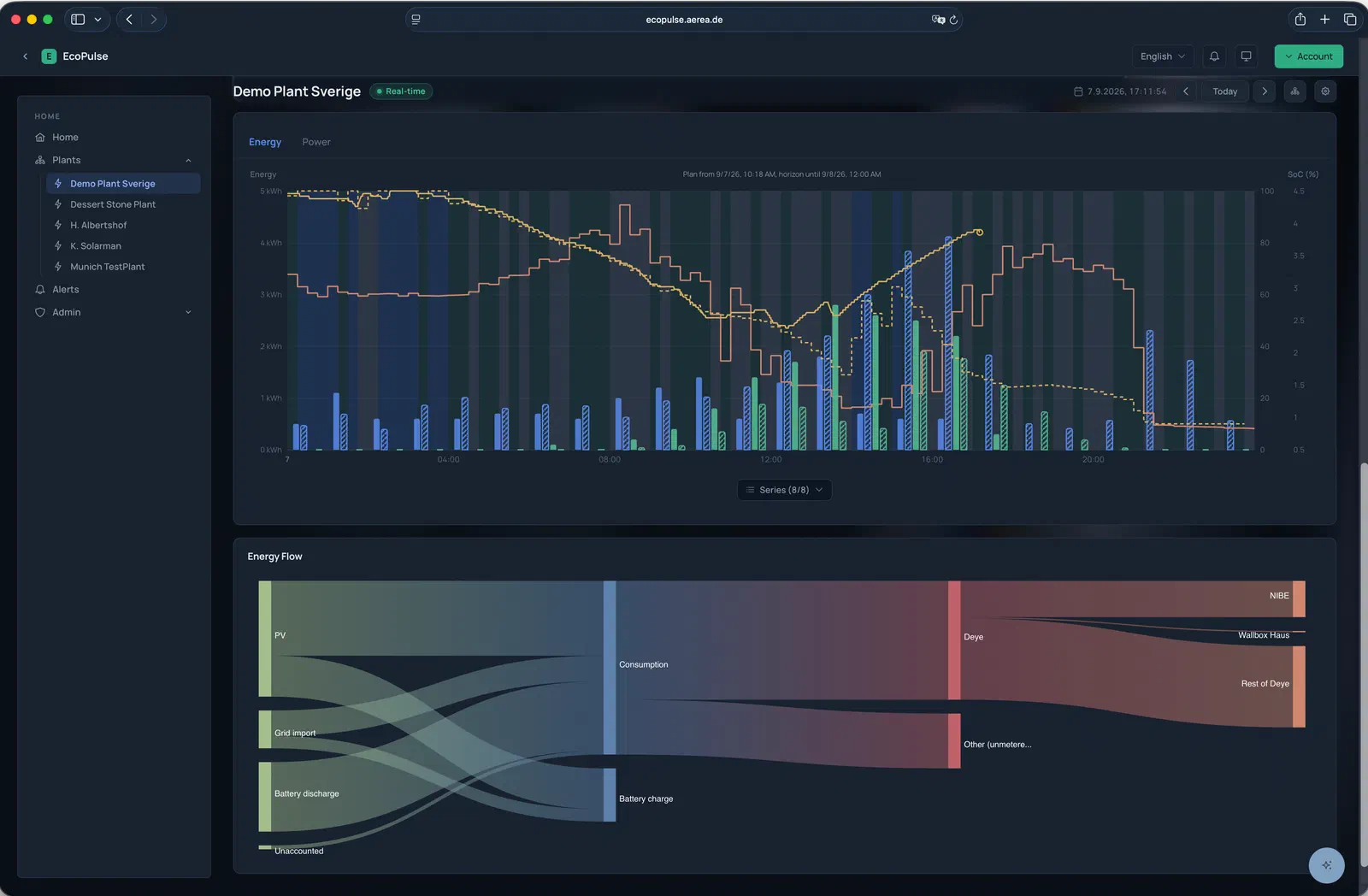
- Forecasts
- PV yield from weather and plant geometry with a learned correction, a load profile from your own readings, the heat pump as a learned building model
- Prices
- aWATTar and ENTSO-E day-ahead; optionally a price forecast beyond the published horizon
- Objective
- spot price plus a cycle cost on grid-charged energy, round-trip efficiency included; energy left in the battery is valued at its replacement price
- Solver
- mixed-integer optimisation, checked by the simulator; where the model falls short, a genetic algorithm takes over
- Limits
- operator SoC band, allowed operating modes, grid connection limits; the heat pump in hourly blocks with comfort bounds
See what the plant does. And why.
A live view that refreshes about once a second, KPIs computed from raw readings rather than vendor figures, and alerts that reach you before the neighbour asks why the plant is down.
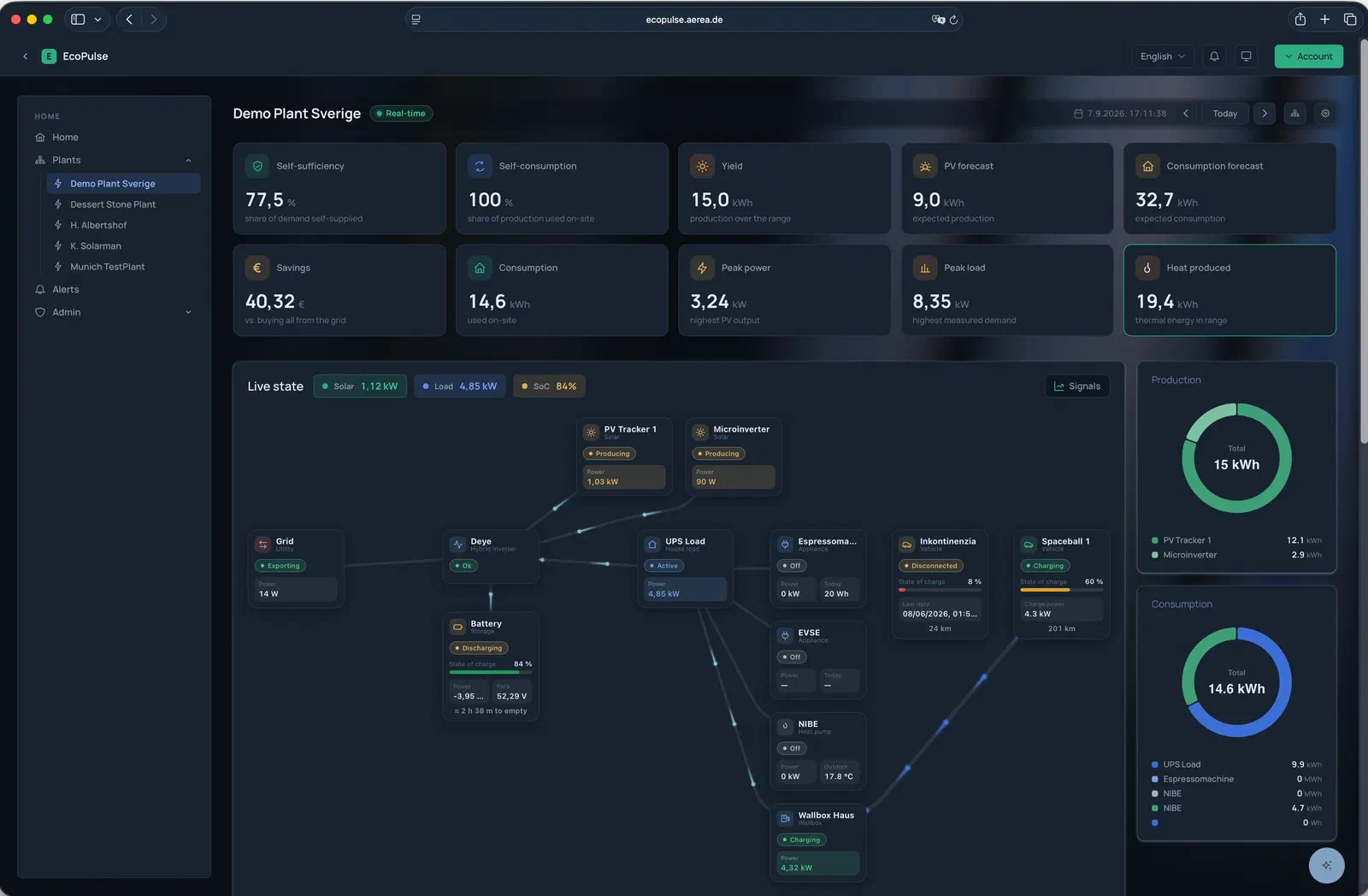
- Self-sufficiency
- share of demand you cover yourself
- Self-consumption
- share of production you use yourself
- Savings
- versus buying everything from the grid, with your tariff
- SPF · MPF · COP
- heat pump performance factors, yearly, monthly, right now
- Cell history
- cell voltages, balancing and drift per pack, hourly forever
- AlertThresholds, stale signals and gateway offline
- AlertEmail, in-app and push to your phone
- AlertMaintenance windows that silence everything and forget nothing
Your plant. Your access.
- Gateways with certificatesEvery gateway has its own identity from our PKI and talks to the broker over mTLS only. There are no passwords on this path any more.
- Signed commandsWhat the cloud sends to the gateway is signed; the gateway verifies before it switches.
- Sign-inOpenID Connect with Google, Microsoft or Apple, or classic password with optional two-factor authentication.
- Rights per plantOwners, teams and shares per plant; without access, a plant appears in no list at all.
- OperationsBuilt and operated by AereA GmbH in Thuringia, Germany, with logs, metrics and traces across the whole path.
Open to your home lab.
- Home Assistantreads the gateway locally, without the cloud, over a versioned API with one token per integration
- Node-REDruns on the gateway; your flows get the readings and may switch
- MCP and assistantan MCP server in the API and an assistant that answers questions like “how was self-sufficiency last week?”; write actions need your confirmation
- Exportplant configuration as a file, time series over the REST API
Who this is for.
- Plant ownersYou have PV, a battery, maybe a wallbox and a heat pump, and five apps. You want one that computes instead of merely displaying.
- InstallersYou build mixed-brand plants and want one interface for all customers, with alerts before the customer calls.
- Commercial operatorsSeveral sites, fleets, peak loads. You need rights per plant, optimisation against the market and traceability.
- Self-buildersSeplos, JK, Batrium, Victron, Home Assistant. You want to see cell data and control locally without locking yourself in.
Frequently asked questions
What do I need to take part?
A plant with at least one supported device and either an EcoPulse gateway on site or a device that talks to the cloud directly: Deye with a Solarman logger, an OCPP wallbox or a Tesla. Which combination is up next we decide group by group; that is why the form asks about your devices.
Does my plant keep running if EcoPulse or the internet fails?
Yes. The gateway runs the assistants locally and buffers the readings. The optimizer in the cloud plans ahead; its last plan stays valid, and without the cloud the devices fall back to their local rules, never to “off”.
My device is not on the list.
Put it in the form. Devices are data contracts for us, not special code; whether and when a family is added depends on how many ask for it and whether we can get a unit to test.
What does EcoPulse cost?
There is no pricing model yet. Those who join now hear about it first and help shape it.
Where does my data live?
On servers AereA GmbH operates itself. The gateway talks to our broker over MQTT with certificates only; third parties get nothing. For plants with data-sovereignty requirements we can operate the whole stack on site.
Who is behind it?
AereA GmbH from Unterweißbach in Thuringia, Germany, a software company for industrial automation, energy and telecommunications since 2009. EcoPulse is our own product and has been running on our own and partner plants for two years.
Put your plant on the list.
Tell us what is attached. We get in touch as soon as your device combination is up, and set the plant up together with you.
Thanks, you are on the list.
We will email you as soon as your device combination is up.